In Germany, you don’t always need to visit a police station to report a crime. Many states offer an online reporting system called the Internetwache (literally “internet guard post”) where you can file a complaint from home — in minutes. Here’s exactly how to do it.
- Find the Polizei website for your state
Germany’s police system is decentralized — each of the 16 federal states (Bundesländer) has its own police authority and its own online portal. There is no single national system, so the first step is finding the right one for where you live.
- Search Google for your city or state name + “Polizei Internetwache” — for example, “Polizei Internetwache Nordrhein-Westfalen” or “Polizei Berlin online Anzeige.”
- Make sure you land on an official .nrw.de, .de, or state government domain — not a third-party site.
- Alternatively, go directly to your state police website (e.g. polizei.nrw for NRW) and look for the Internetwache section in the menu.
Some state portals for referenceNordrhein-Westfalen: polizei.nrwBayern: polizei.bayern.deBerlin: polizei.berlin.deHamburg: polizei.hamburg.deBaden-Württemberg: polizei-bw.deHessen: polizei.hessen.deNot all states support online complaints for every type of offence. Some states have more limited portals than others. If your offence isn’t listed, you may need to visit your local police station (Polizeiwache) in person.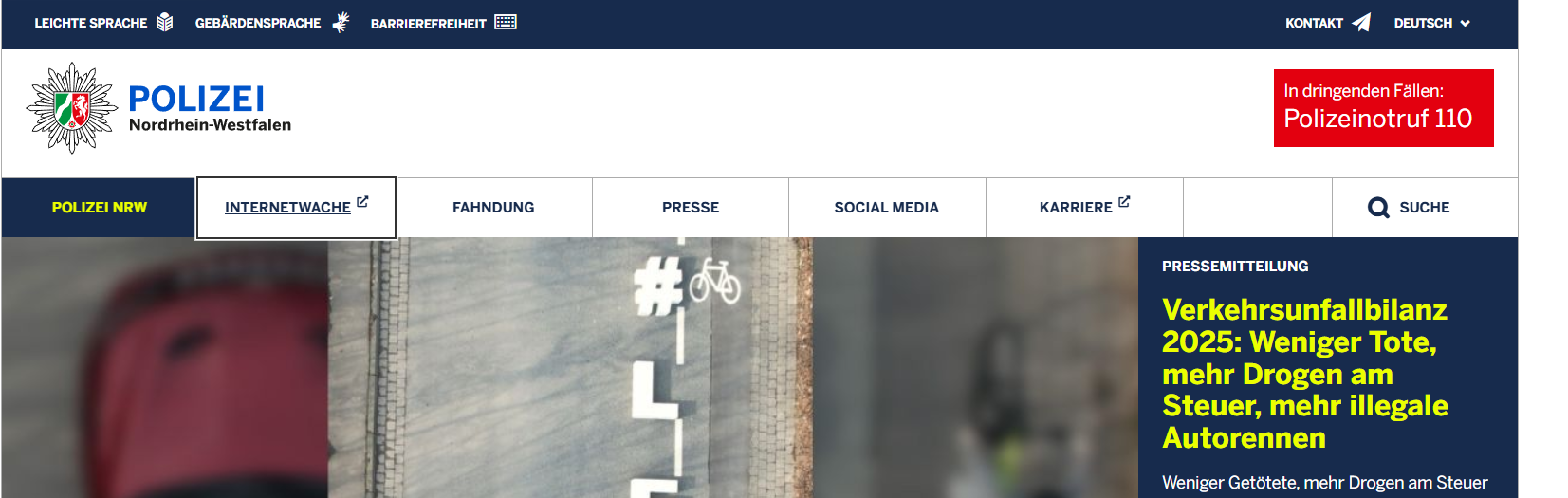
-
Go to the Internetwache section
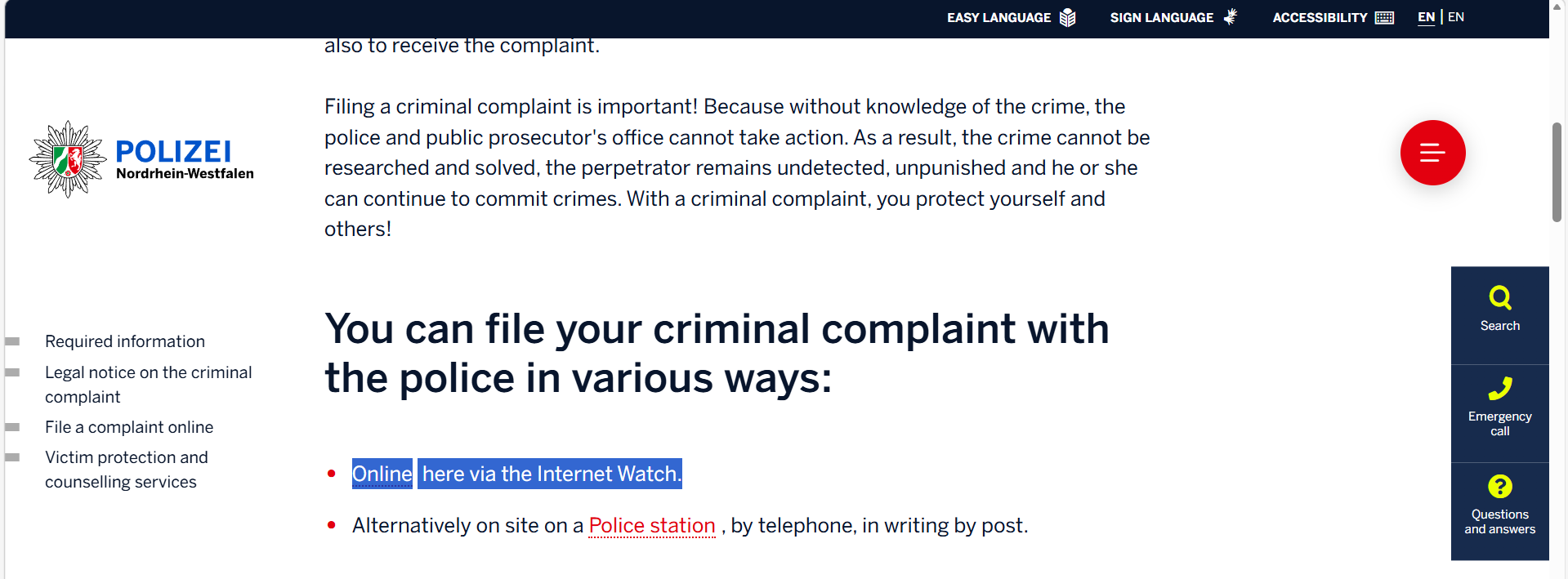
Once you’re on the correct state police website, look for a section called Internetwache or Online-Anzeige. This is the digital equivalent of walking into a police station to report something.
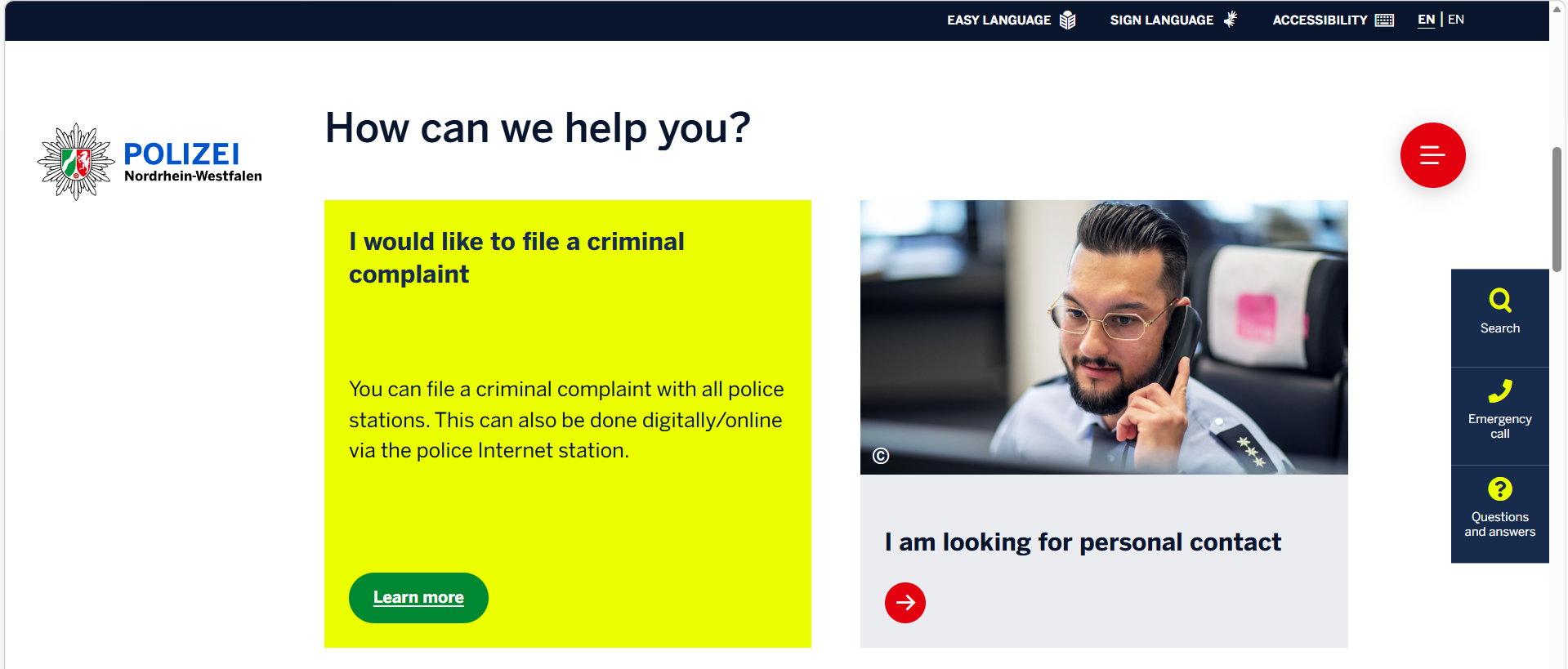
- It is usually prominently linked on the homepage or under a “Services” or “Bürgerservice” menu.
- For Nordrhein-Westfalen, the direct portal is at internetwache.polizei.nrw.de.
- The portal is typically in German — if you’re not comfortable with German, use your browser’s built-in translation feature (Chrome and Edge both do this well) to get an English version of the page.
- You do not need to create an account or log in on most portals — the process is largely anonymous until you fill in your personal details in the form itself.
Some portals also offer an English-language option — look for a language switcher (EN / Englisch) at the top of the page before you start. -
Click on “I would like to file a complaint”
On the Internetwache landing page, you’ll typically see a few options. Look for the button or link that says something like:
- “Ich möchte eine Anzeige erstatten” — I would like to file a complaint
- “Online-Anzeige stellen” — File an online report
- “Anzeige erstatten” — Report an offence
- Before proceeding, the portal usually shows a short information page explaining what types of crimes can be reported online, what information you’ll need, and any limitations.
- Read this page carefully — it often lists offences that are not accepted online (e.g. crimes in progress, emergencies, or offences requiring immediate investigation).
- If it’s an emergency or a crime is happening right now — call 110 immediately. The online system is for non-urgent reports only.
The Internetwache is strictly for non-emergency situations. If you or someone else is in danger, call 110 (police) or 112 (fire/ambulance) immediately — do not use the online portal. -
Select the type of offence
The portal will ask you to select the category of crime you’re reporting. This helps route your complaint to the right department. Common categories you’ll typically see include:
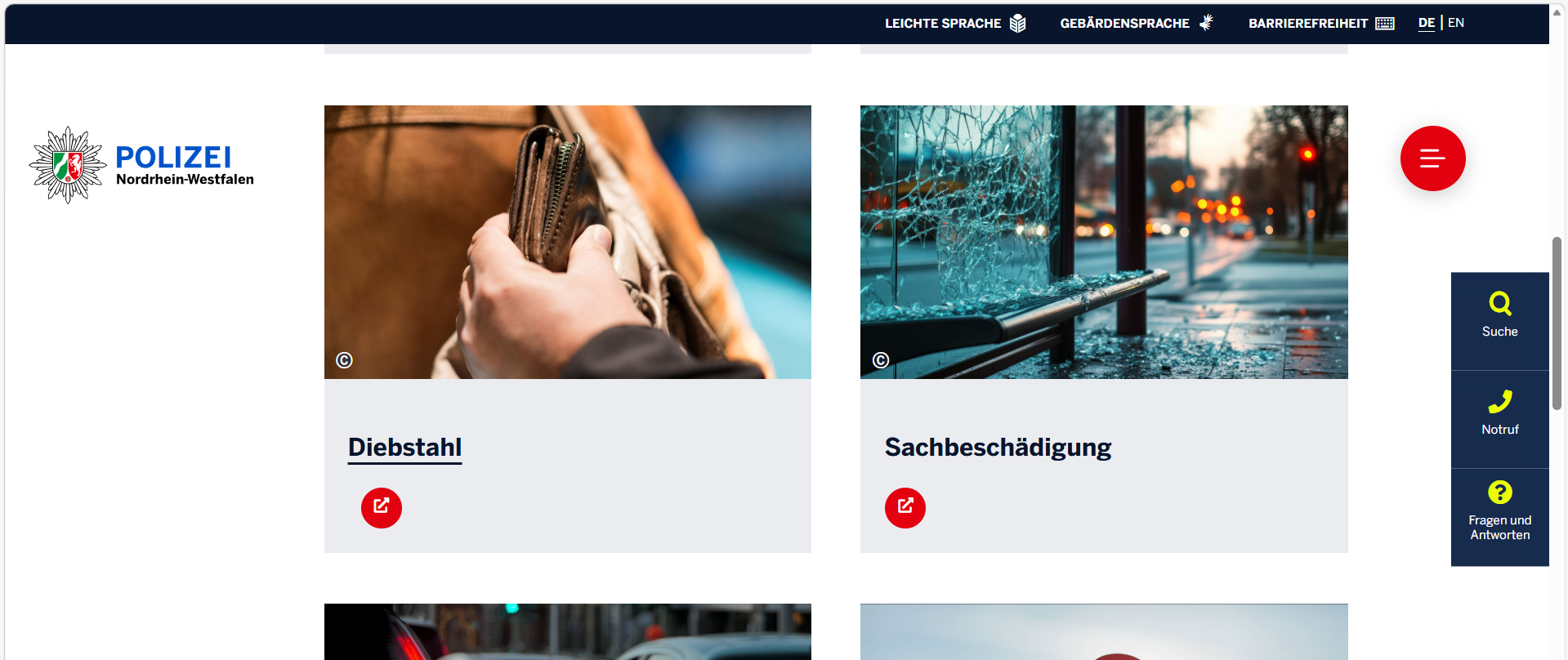
- Diebstahl — Theft (e.g. pickpocketing, bike theft, stolen bag)
- Betrug — Fraud (e.g. online scams, fake sellers, phishing)
- Sachbeschädigung — Property damage (e.g. vandalism, scratched car)
- Beleidigung — Insult / defamation
- Körperverletzung — Bodily harm / assault
- Hausfriedensbruch — Trespassing
- For this example, we’ll use Diebstahl (Theft) — one of the most commonly reported crimes online in Germany.
- If you’re unsure which category fits, pick the closest one and describe the situation clearly in the free-text fields later in the form.
- Some portals let you select multiple categories if the incident involves more than one type of offence.
Not sure what category your situation falls under? Describe it in German to your browser’s translation tool or briefly to a friend — the category names are fairly descriptive once translated. -
Fill in the form and submit
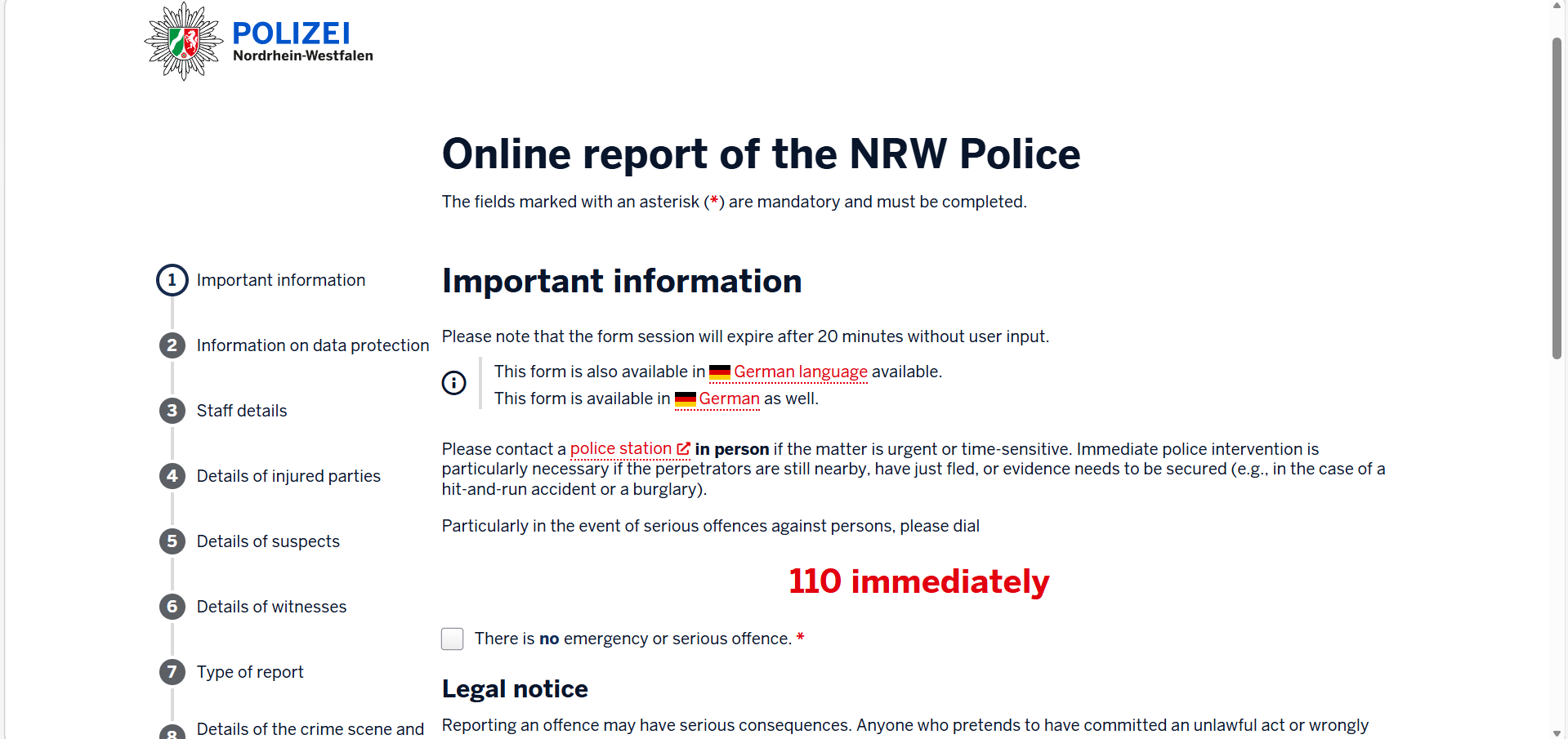
The form is usually split into multiple steps. Each step covers a different aspect of the incident. Here’s what to expect and how to fill each part well.-
Your personal details:
Full name, address, date of birth, contact number and email. This is required — anonymous complaints are generally not accepted for official Strafanzeigen. - Incident details:
Where and when it happened. Be as specific as possible — street name, date, approximate time. - Description of the offence:
A free-text field where you describe what happened in your own words. Write clearly and chronologically. Stick to facts. - What was stolen / damaged:
List items with estimated values. For theft — include brand, model, serial number if known (especially for bikes and electronics). - Suspect information:
If you saw the person — describe appearance, clothing, direction of travel. If unknown, leave it blank. - Witnesses:
Names and contact details of anyone who saw what happened, if applicable. - Evidence / attachments:
Some portals let you upload photos, screenshots, or documents. Attach anything relevant — especially for online fraud cases.
-
-
Tips for filling the form
- Write your description in German if possible — it reduces processing time. If not, write in English and note at the top: “I am writing in English as I am not fluent in German.”
- Be factual and concise — avoid emotional language. Police reports are formal documents.
- Double-check all dates, times, and addresses before submitting. Errors can slow down the investigation.
- At the end, you will be asked to confirm the accuracy of your statement — this is a legal declaration, so make sure everything is correct.
After you submit- You will receive a confirmation — usually a reference number and a PDF copy of your complaint sent to your email. Save this.
- The complaint is officially registered as a Strafanzeige (criminal complaint) and forwarded to the relevant police department.
- You may be contacted by the police for follow-up questions or to attend an interview — especially if the case requires further investigation.
- For insurance claims (e.g. stolen bike or phone), the complaint reference number is what your insurer will ask for. Keep it handy.
Leave a Reply